
Calculate Your Pay Rise
My current salary
What I want extra
Student loan repayments are deducted automatically once you earn above $54,435/year
Most employees claim this. Only untick if this is a second job.
If super is on top, your employer pays 12% extra. If included, your take-home will be lower.
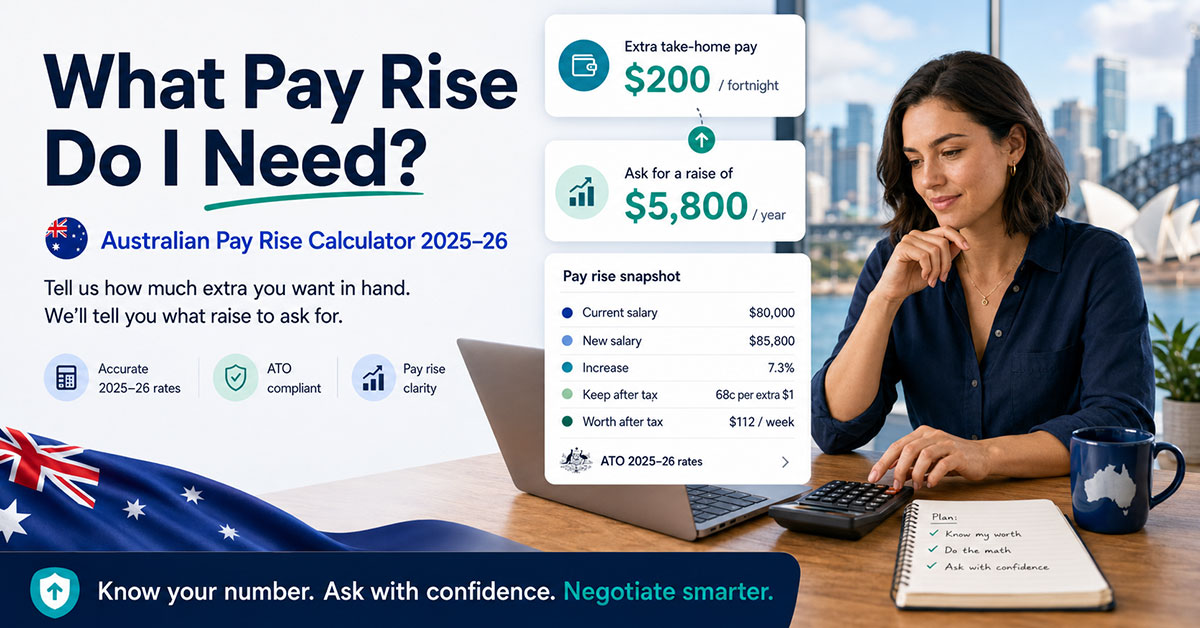
To get $200/fortnight extra in your pocket, ask for a pay rise of:
per year
That's a 7.3% increase on your current salary
Your pay comparison
| Current | After raise | |
|---|---|---|
| Gross salary | $80,000 | $85,800 |
| Income tax | −$17,547 | −$19,372 |
| Medicare levy | −$1,600 | −$1,716 |
| Take-home pay | ||
| Net pay (annual) | $60,853 | $64,712 |
| Net pay (monthly) | $5,071 | $5,393 |
| Net pay (fortnight) | $2,340 | $2,489 +$149/fn |
| Net pay (weekly) | $1,170 | $1,244 |
| Super & costs | ||
| Employer super (12%) | $9,600 | $10,296 |
| Summary | ||
| Effective tax rate | 24.7% | 25.1% |
💡 The tax reality of pay rises
On a salary between $45,001 and $120,000, every extra dollar you earn is taxed at 32.5% income tax (plus 2% Medicare levy). That means for every $1,000 extra your employer pays, you keep $655.
This is your marginal tax rate — and it's why the number you ask for needs to be higher than the number you want in your pocket.
Estimates based on 2025–26 ATO rates. Individual circumstances may vary — consult a registered tax agent for advice specific to your situation.